

Medical imaging workflows
Build tools for image intake, annotation, model-assisted review, and specialist feedback around an agreed clinical use case.
Bring data, AI outputs, and specialist review into a clear workflow. We help diagnostic product teams develop applications with traceable evidence, practical interfaces, and defined evaluation milestones.
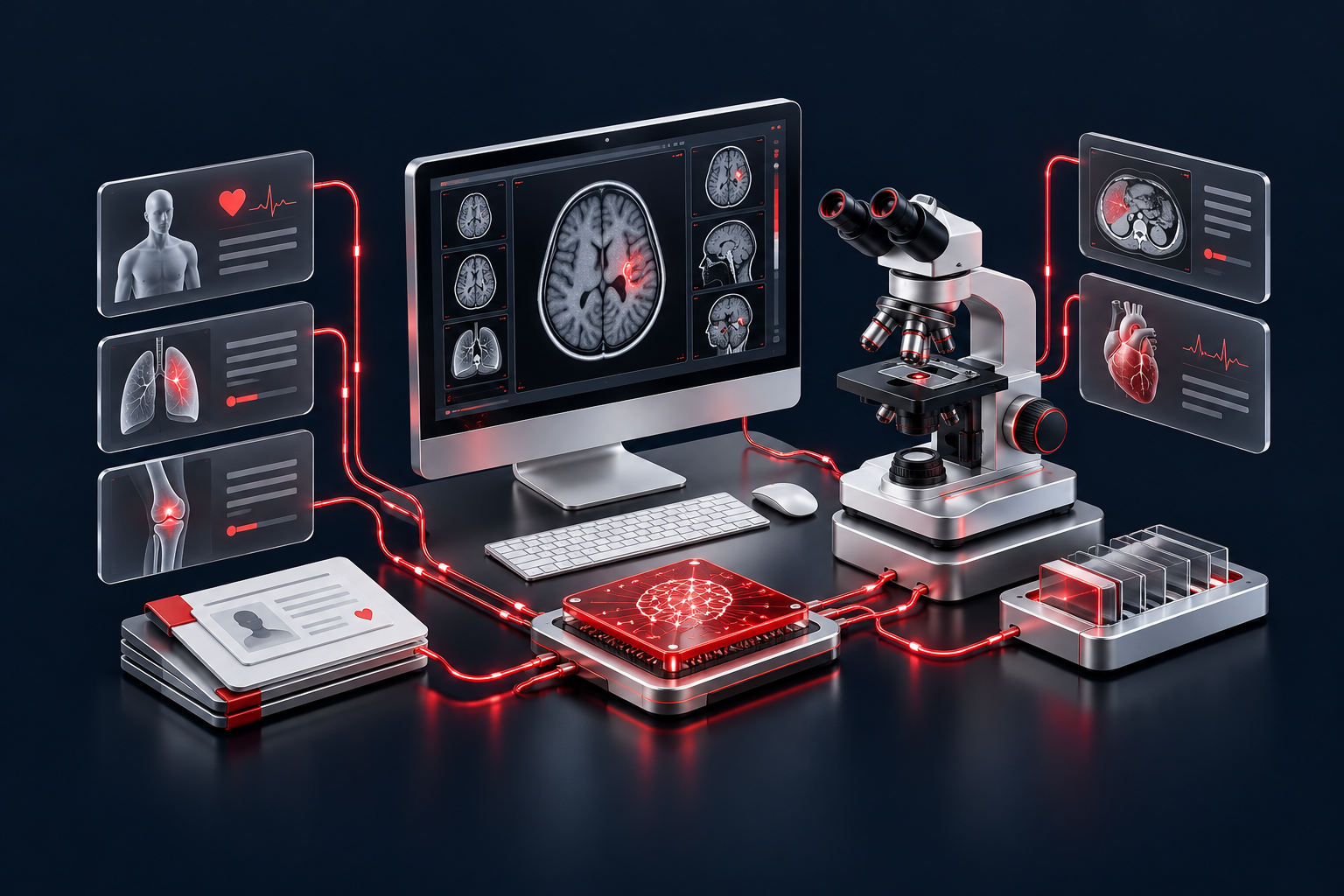
Build the application, data, and review capabilities your diagnostic product needs.
Build tools for image intake, annotation, model-assisted review, and specialist feedback around an agreed clinical use case.
Prepare traceable datasets with defined labeling, quality checks, and access controls for development and evaluation.
Develop and evaluate models against agreed benchmarks, with documented limitations and review by domain specialists.
Give qualified reviewers clear access to source information, model outputs, and recorded decisions.
Connect supported clinical systems and data sources with explicit patient matching, validation, and error handling.
Track model versions, evaluation results, reviewer feedback, and operational changes through a defined oversight process.
Shared milestones keep business stakeholders and engineering teams aligned throughout delivery.
Clarify the clinical question, intended users, available evidence, and boundaries of the proposed software.
Map data movement and prototype how clinicians inspect results, uncertainty, and supporting information.
Agree on datasets, evaluation criteria, specialist involvement, and release dependencies.
Develop data pipelines, model interfaces, and review tools in reviewable increments.
Assess the agreed use case with representative data and specialist review before release decisions.
Plan a controlled rollout with monitoring, model versioning, support responsibilities, and change review.
Align product engineering with the specialists who understand the intended clinical use.
Keep specialist review and practical clinical tasks central to the product experience.
Connect outputs to the source data, model version, and evaluation records behind them.
Plan integrations alongside the application so data and workflow dependencies are visible early.
Agree on technical, clinical, and review ownership throughout development and rollout.
Tell us about your use case, available data, and intended users. We’ll outline the engineering scope and review dependencies for a focused first step.
Choose the balance of collaboration, responsibility, and scope your project needs.
Bring engineering, data, or interface expertise into your existing diagnostic product team.
For an established product roadmap.
Discuss this approachAlign application, data, and model engineering through a shared delivery plan.
For ongoing product development.
Discuss this approachAgree on a prototype, integration, or evaluation workflow with clear deliverables.
For bounded requirements and review milestones.
Discuss this approachClinicians, researchers, and product teams
Clear scope and integration owners
Evaluation and review criteria
Practical handover and support
Present model outputs alongside relevant context and a clear route for qualified specialist review.
Document evaluation datasets, known limitations, and changes that may affect model behavior.
Make source records, review status, and next actions easy for clinical teams to understand.
Hire specialists across AI, web, mobile, cloud, data, and enterprise software.
See the application and platform work featured across AsonTech Solutions.
Answers about diagnostic workflows, model evaluation, integrations, and delivery.
Projects can include data preparation, model development, imaging workflows, clinical review tools, integrations, and monitoring. The exact scope starts with the intended use and available data.
Our proposed workflows center on qualified clinical review. The intended role of each output, its limitations, and the decisions it may support must be defined and evaluated for the specific product.
Yes. We can assess its interface, documentation, input requirements, and evaluation evidence before planning application integration and monitoring.
We first assess data availability, permitted use, labeling quality, and relevance to the intended users and setting. Access and handling requirements are agreed before development.
We review supported interfaces, data formats, patient identifiers, and access arrangements. Integration scope depends on the capabilities and permissions of the connected systems.
Evaluation criteria are defined for the specific use case with domain specialists. The plan considers representative data, error patterns, subgroup results where relevant, and the limits of the evidence.
A release plan defines technical testing, clinical review, applicable approval dependencies, monitoring, and ownership. We do not treat a prototype or a benchmark result as readiness for clinical deployment.